

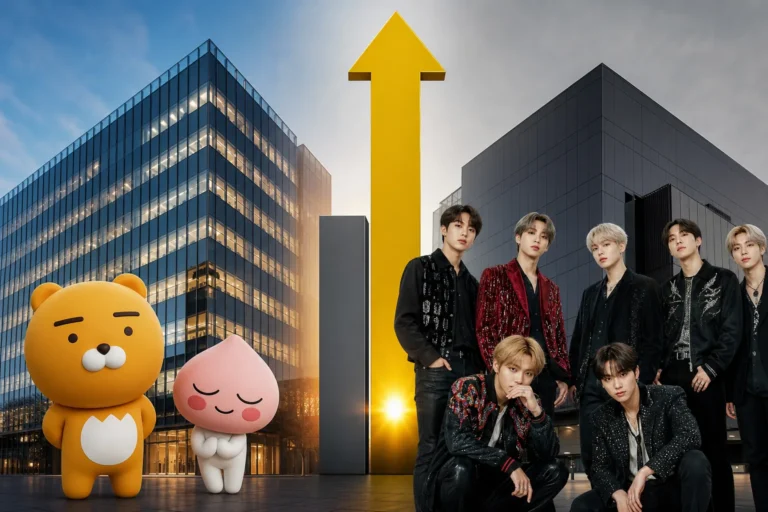
Kakao’s entertainment network has moved ahead of HYBE in a closely watched ranking of South Korean entertainment company revenue, underscoring how quickly the business map around K-pop can shift when major labels, touring, and intellectual property are counted together.
The change is notable because HYBE has often been treated as the clearest symbol of K-pop’s global commercial expansion. The company built its position through BTS, SEVENTEEN, TXT, ENHYPEN, LE SSERAFIM, NewJeans, and other acts across its multi-label system. But the latest ranking places Kakao’s entertainment agencies first, with HYBE in second, showing that scale in the Korean entertainment sector is no longer defined by one company or one group of artists alone.
SM Entertainment Proves Decisive
A central factor behind Kakao’s rise is SM Entertainment. SM recorded revenue of 813 billion won, or roughly $559 million, marking a 22.6 percent increase from the previous year. That performance gave Kakao a powerful anchor inside the music and artist-management market, especially as SM remains one of the industry’s most influential legacy agencies.
SM’s role matters beyond the headline number. The company manages a catalog and artist roster that stretches across generations of K-pop, from veteran acts to current global performers. Its business also extends through albums, concerts, fan merchandise, production systems, and overseas activity. When that scale is folded into Kakao’s broader entertainment holdings, it gives Kakao a wider revenue base than a single agency structure would provide.

Kakao’s position reflects the continuing consolidation of Korean entertainment. Rather than relying only on one flagship label, large corporate groups now compete through portfolios of agencies, distribution channels, platforms, and production arms. That model can soften the impact of a quiet cycle for one artist while amplifying the upside when multiple labels are active at once.
HYBE Still Holds Major Market Weight
HYBE’s second-place position does not suggest a loss of relevance. The company remains one of the strongest forces in global K-pop, supported by labels such as BigHit Music and PLEDIS Entertainment. Its artist ecosystem continues to drive album sales, touring demand, brand partnerships, and international attention. The ranking instead shows that competitors with broad entertainment portfolios can challenge HYBE’s revenue leadership when their key subsidiaries perform strongly.
That distinction is important for fans and industry observers. K-pop’s largest companies are no longer competing only on music releases or domestic popularity. They are competing across live events, fan communities, content production, publishing, licensing, and international market access. A company can gain ground through a strong concert year, a successful album cycle, a breakout new artist, or a more efficient use of existing intellectual property.
JYP Entertainment ranked third with revenue of 684 billion won, about $470 million. YG Entertainment ranked fourth with revenue of 339 billion won, about $233 million, with its results helped by expanded concert activity and a sharp year-over-year increase. Together, the four major groups accounted for a large majority of revenue among the top 30 companies in the ranking.

The concentration highlights both the strength and the pressure inside Korea’s entertainment market. Large agencies can fund global tours, high-budget music videos, international promotions, and long-term trainee systems. Smaller companies, meanwhile, face a tougher climb when competing for attention, venues, advertising, and platform visibility. As a result, even successful mid-sized acts may need strategic partnerships or distribution support to grow beyond a domestic base.
Why The Ranking Matters
For Kakao, the ranking strengthens the argument that its entertainment assets are a major part of its broader media and technology strategy. Music labels do more than release songs; they create intellectual property that can travel across streaming, video, live events, fandom platforms, endorsements, and scripted or unscripted content. SM’s performance gives Kakao a high-profile engine inside that strategy.
For HYBE, the result adds pressure to keep proving that its multi-label structure can deliver steady growth across artist cycles. BTS’s full-group future, SEVENTEEN’s global reach, newer label projects, and platform-driven fan services all remain central to how the company is evaluated. Revenue leadership can change quickly in a sector where comeback timing, touring schedules, and global demand all affect annual results.
The broader takeaway is that K-pop’s corporate competition is entering a more mature phase. The leading companies are still shaped by star power, but their rankings increasingly depend on how effectively they manage portfolios, expand concerts, monetize catalogs, and connect artists to global audiences. Kakao’s move ahead of HYBE is therefore less a single upset than a sign of a market where the biggest players are now fighting on several fronts at once.



Join the Conversation
Log in to share your thoughts and join the conversation with other fans.