
IU Seeks U.S. Court Help to Identify Threads User in Defamation Case

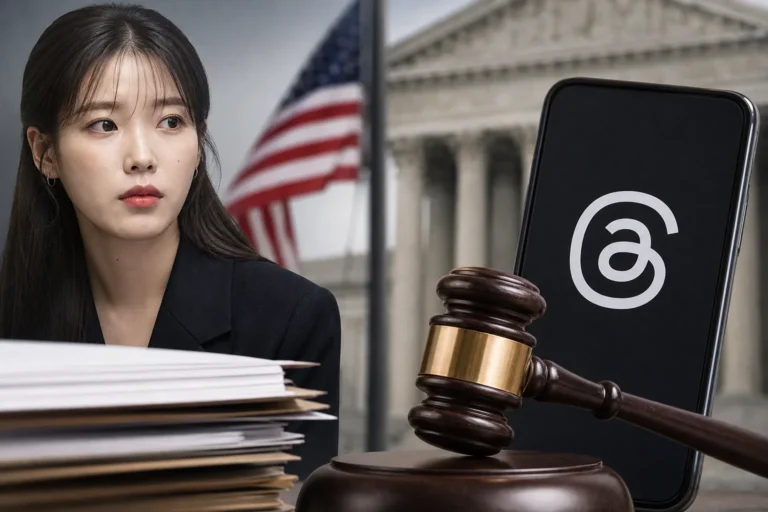
IU has taken another formal step in her long-running fight against online defamation, asking a U.S. federal court to help identify an anonymous Threads user accused of spreading false and damaging claims about her. The singer and actress, whose legal name is Lee Ji-eun, is seeking subscriber information from Meta as part of a civil defamation case already underway in South Korea.
The request was filed in the U.S. District Court for the Northern District of California, where Meta is subject to court jurisdiction. IU’s legal team is using a procedure that allows evidence located in the United States to be obtained for use in foreign legal proceedings. If granted, the order could require Meta to provide records linked to the Threads account at the center of the dispute.
A Cross-Border Request For Platform Records
The filing targets an anonymous Threads account identified in the proceeding by a partially masked username. IU’s representatives allege that the account published or shared 52 posts over a seven-month period from March to October 2025. They argue that the posts contained false statements that harmed her reputation, public image, and professional standing.
The information being sought reportedly includes subscriber details such as a name, address, phone number, email address, and IP records associated with the account. Those records would not decide the South Korean defamation case on their own, but they could help identify the person behind the account and allow the case to proceed against a specific defendant.
The dispute highlights a recurring problem for public figures in Korea’s entertainment industry: harmful online posts can travel across global platforms even when the underlying lawsuit is being handled in Korean courts. When anonymous accounts are hosted by companies based outside Korea, plaintiffs often need assistance from foreign courts to connect an account to an individual user.
What The Posts Allegedly Claimed
IU’s side says the posts involved several categories of claims, including repeated plagiarism allegations, statements about her background and international popularity, accusations connected to media manipulation, and assertions tying her music or public image to sensitive national events. Her representatives also challenged claims about her charitable work and global achievements by submitting performance records and streaming data.
Some of the plagiarism-related allegations have already been addressed in a separate South Korean court matter. In 2024, a damages ruling of 30 million won, roughly $22,000, was issued against a person responsible for spreading similar claims. IU’s legal team is now arguing that the Threads posts continued a pattern of harmful misinformation despite earlier legal findings.
The current U.S. request does not mean the anonymous user has been found liable. It is a discovery step designed to gather identifying information and evidence for the Korean case. Any final determination about liability, damages, or penalties would depend on the court handling the underlying proceedings.
IU’s Broader Legal Strategy
IU and her agency have maintained a strict posture toward malicious online activity, particularly posts that they say cross from criticism into false factual accusations or personal attacks. As of earlier this year, her legal team had pursued criminal complaints and civil lawsuits against dozens of individuals accused of posting harmful content. One defendant received a suspended prison sentence in May after losing an appeal over repeated insulting posts.
That broader enforcement strategy reflects a shift in how major Korean entertainers and agencies respond to online abuse. Rather than limiting responses to public statements, agencies increasingly collect evidence, preserve screenshots, identify accounts, and pursue legal action across multiple jurisdictions when platform records are held overseas.
For IU, the case arrives as she remains one of Korea’s most visible singer-actresses, with a career spanning music, television, film, advertising, and international events. That visibility can magnify the impact of online rumors, especially when claims are repeated across platforms and presented as factual information.
The U.S. court will first have to decide whether Meta should be ordered to provide the requested records. If the request is approved and usable account information is produced, IU’s team could use those details to continue the South Korean defamation case against the person they believe operated the Threads account.
The matter is also likely to draw attention from fans and industry observers because it sits at the intersection of celebrity reputation, anonymous speech, and global platform accountability. As K-pop and Korean entertainment become more internationally connected, disputes that begin with posts on social media can quickly become cross-border legal cases involving courts, technology companies, and entertainment agencies.



Join the Conversation
Log in to share your thoughts and join the conversation with other fans.