

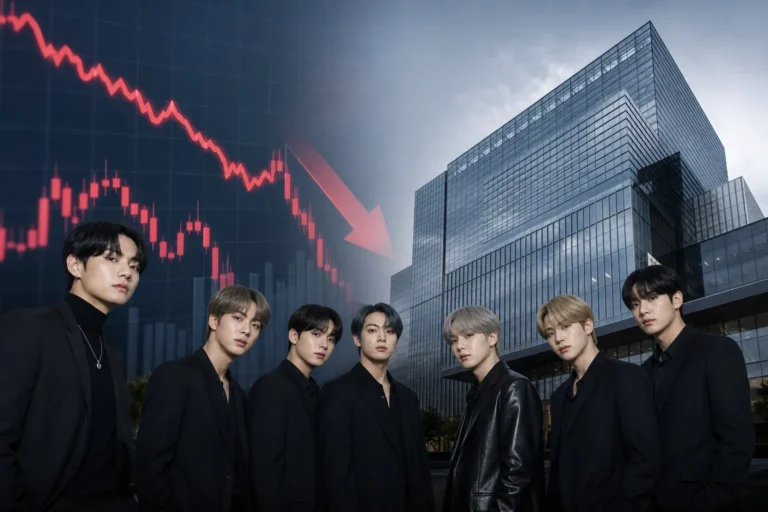
HYBE is facing a striking divide between its latest operating results and the way investors are valuing the company. The K-pop powerhouse posted its strongest quarterly revenue and operating-profit figures to date, yet its shares have continued to trade far below their earlier highs. The gap has turned attention from the scale of its recent success to the question of what can sustain the next stage of growth.
The company’s share price had previously moved above 410,000 won before falling into the 160,000-won range, a decline of roughly 60% from its 52-week peak. That reversal has also reduced the paper value of Chairman Bang Si Hyuk’s holdings by a substantial amount. For a business closely watched as a barometer of the global K-pop market, the movement has become a broader signal of investor caution.
Record results did not settle market concerns
In the second quarter, HYBE reported 1.45 trillion won in revenue and 170.9 billion won in operating profit. Revenue more than doubled from the same period a year earlier, while operating profit rose even faster. The figures marked a notable milestone for Korea’s entertainment sector: a company crossing both 1 trillion won in quarterly revenue and 100 billion won in operating profit at the same time.
Those results reflect the commercial reach of HYBE’s artist roster, music releases, live events and related businesses. BTS’s full-group activity was an especially important contributor to the company’s performance, helping drive a period of major visibility and demand. But strong earnings alone do not automatically answer the market’s longer-term questions. Share prices tend to reflect expectations for future cash flow, not only a company’s most recent report card.

That distinction appears central to the current debate. Investors are weighing whether an exceptional period built around major global activity can be repeated at a similar pace. The concern is not that HYBE has stopped generating large revenue; rather, it is whether the company’s growth rate can remain as high once a major cycle of releases and touring activity normalizes.
Touring and margins are under scrutiny
Live performances can create enormous revenue, but their profitability is shaped by venue costs, production, travel, staffing and the scale of each tour. Questions around margins in the concert business have therefore become part of the market conversation. A high-grossing tour can strengthen a company’s top line while still prompting investors to examine how much of that revenue becomes operating profit.
The focus on BTS also illustrates the challenge of managing expectations around a group with unmatched global influence. Full-group projects can bring powerful momentum to album sales, ticketing, merchandise and attention across the wider corporate portfolio. At the same time, the very scale of that impact can lead investors to ask how earnings will develop during periods with a different release or touring schedule.

HYBE’s position is not defined by one artist alone. Its portfolio includes multiple active groups, labels and overseas operations, giving it more avenues for new music, performances and fan-platform revenue. The test for the company will be demonstrating how those businesses can convert their reach into resilient, repeatable growth alongside its largest global acts.
A wider read on K-pop’s business cycle
The share-price pressure also arrives as investors reassess the industry’s traditional growth engines. Physical album sales have been a major revenue source for Korean entertainment companies, but the pace of expansion has faced closer attention. Meanwhile, capital has flowed toward other large Korean sectors, including technology and semiconductor companies, raising the bar for entertainment stocks competing for investor interest.
For HYBE, the immediate picture is therefore mixed: record operating results on one side, and a market demanding more evidence about durability on the other. The company’s future performance will likely be judged on how effectively it balances blockbuster moments with a broader pipeline of artists, profitable events and diversified revenue. The latest quarter established the size of HYBE’s current business; the market is now focused on what comes after the peak.



Join the Conversation
Log in to share your thoughts and join the conversation with other fans.